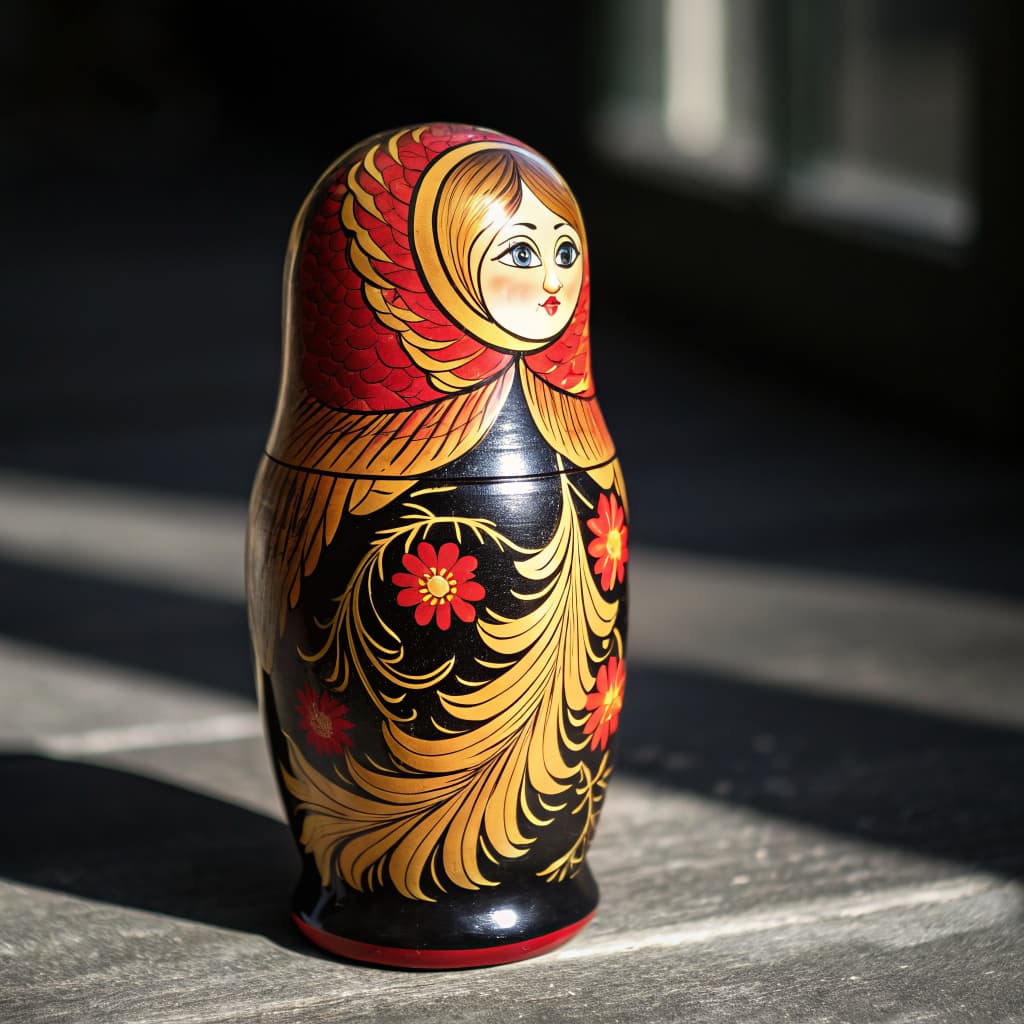
Three Schools, Three Souls: Regional Painting Styles of the Matryoshka
If you line up three matryoshka dolls from the three great Russian production centers — Sergiev Posad, Semyonov, and Polkhov-Maidan — you might not immediately believe they belong to the same art form. The palettes differ. The brushwork differs. Even the shape of the blank and the species of wood beneath the paint differ. Each school developed its own answer to the question of what a nesting doll should look like, and those answers tell you as much about the region and its people as they do about the craft.
Sergiev Posad, the birthplace of the matryoshka, established the template. Located about seventy kilometers northeast of Moscow, the town (known as Zagorsk from 1930 to 1991) had been a center of toy production for centuries before the first nesting doll arrived. Sergiev Posad dolls are turned from linden wood and painted in a restrained, realistic style. The traditional figure depicts a young woman in a kerchief and sarafan (folk dress) with an apron, rendered in only three or four colors — typically red, yellow, and green — with crisp black contour lines defining every fold and feature. The faces are carefully modeled, with rosy cheeks and a gentle expression. There is nothing loud about a Sergiev Posad matryoshka; its authority comes from precision and quiet warmth. Sets from this school usually contain between three and twelve pieces, though twenty-piece sets exist.
Semyonov is a different world. Situated in the Nizhny Novgorod region — a landscape of birch forests and old-believer villages — this school emerged in the 1920s when local artisans began adapting the matryoshka form to their own decorative traditions. The differences start with the wood: Semyonov dolls are turned from birch, which is harder and heavier than linden, giving the finished pieces a satisfying density in the hand. The artists traded gouache for aniline dyes — synthetic pigments derived from coal tar — which produce colors of startling intensity. Where Sergiev Posad painters focus on the figure's costume and face, Semyonov artists pour their energy into a massive floral bouquet that dominates the apron. The flowers are large, stylized, and layered, drawing on the ornamental vocabulary of ancient Russian manuscript illumination. The result is a doll that practically vibrates with color. Semyonov sets are also notable for their size: sets of 15, 18, or even 20 pieces are common, requiring extraordinary precision from the lathe operator.
Polkhov-Maidan, the youngest of the three schools, began producing matryoshka around 1930. Located in the same Nizhny Novgorod region as Semyonov, the village developed a style so distinctive that it is impossible to confuse with the other two. Polkhov-Maidan dolls are elongated, with a small, slightly flattened head and a body that tapers more sharply than either the Sergiev Posad or Semyonov forms. The painting is bold to the point of exuberance: crimson, yellow, green, violet, and blue applied with water-soluble aniline paints, outlined in black India ink. The signature motif is the multi-petaled dog rose (rosehip), a flower long associated in Russian folk symbolism with motherhood and love. Unlike the meticulous realism of Sergiev Posad or the ornamental abundance of Semyonov, Polkhov-Maidan painting has a deliberately naive, almost childlike quality — broad strokes, high contrast, zero subtlety. Art historians have compared the aesthetic to peasant embroidery and folk ceramics.
The technical processes behind each school reinforce their visual differences. In Sergiev Posad, the painter begins by mapping the figure with a fine charcoal sketch, then builds the image with multiple thin layers of gouache, adding highlights and shadows in the manner of icon painting. The lacquer finish is oil-based, producing a deep, warm gloss. In Semyonov, the blank is first dipped in a starch paste that seals the wood and creates a ground for the aniline dyes, which are applied in broad washes before the floral details are drawn. In Polkhov-Maidan, the craftswomen (the painters there are traditionally women) start by drawing the oval of the face, the outline of the kerchief, and the hands in black India ink, then fill the enclosed areas with brilliant aniline colors, sometimes blending one hue into the next while still wet. The effect is loose, saturated, and utterly unlike the controlled layers of Sergiev Posad.
For collectors, the regional differences are not merely aesthetic — they affect value and rarity. Sergiev Posad dolls, particularly those signed by known masters or produced at the storied Sergiev Posad Toy Factory, command the highest prices for traditional-style matryoshka. Semyonov sets, with their larger piece counts and vibrant colors, are popular gifts and are considered the quintessential "Russian souvenir" abroad. Polkhov-Maidan dolls, though less internationally famous, are prized by specialists for their folk authenticity and their direct connection to village-level craft traditions. Knowing which school produced a doll — and being able to identify the telltale signs — is the first step toward building a collection with depth and intention.
There are subtler regional traditions as well. The city of Tver, northwest of Moscow, developed a school influenced by both Sergiev Posad and local icon-painting traditions, producing dolls with unusually refined facial features. Kirov, far to the northeast, is known for small-scale, inexpensive sets with a distinctly northern aesthetic. And since the 1990s, individual artists across Russia and Ukraine have blended elements from all three major schools into highly personal styles, sometimes incorporating gold leaf, egg-tempera techniques, and even pyrography (wood burning) to create museum-quality one-of-a-kind pieces.
At Artisanal Babushkas, we carry dolls that represent each of these traditions. Our Khokhloma collection draws on the ornamental richness of the Semyonov school. Our Classic Matryoshka line follows the Sergiev Posad tradition of lifelike figures in folk costume. And our Painter's Studio collection showcases contemporary artists who work across — and beyond — these regional boundaries. Understanding the three great schools is not just art history; it is the key to appreciating what makes each doll in your collection distinct.