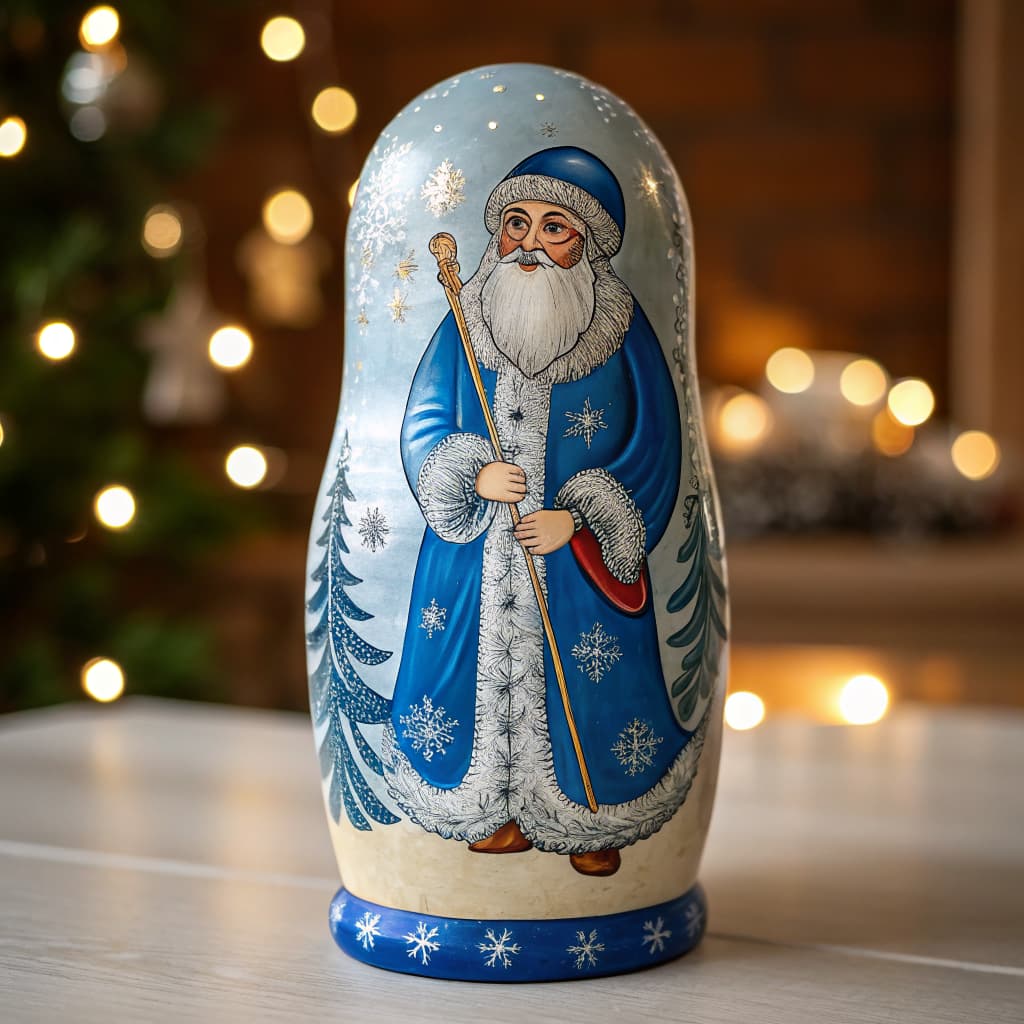
The Gift That Nests Generations: Matryoshka as Heirloom and Tradition
In provincial Russia at the turn of the twentieth century, the matryoshka was not primarily a decorative object or a tourist souvenir. It was a gift — and a very specific kind of gift. Young brides received nesting dolls with as many pieces as possible, the abundance of inner figures serving as a blessing for a large, healthy family. A mother gave a matryoshka to her daughter at her wedding; the daughter, decades later, gave one to her own daughter. The doll traveled from hand to hand, generation to generation, accumulating not just sentimental value but the physical patina of use — a softened lacquer, a mellowed palette, a faint scent of linden and old varnish.
This tradition of matryoshka-as-heirloom persists, though its forms have evolved. In modern Russia and across the Eastern European diaspora, nesting dolls remain among the most common gifts at weddings, christenings, and milestone birthdays. A grandmother might commission a custom set depicting each member of the family, with the patriarch as the outermost figure and the newest grandchild — perhaps still a swaddled infant — at the center. These personalized sets, painted to order by working artisans, blend the folk tradition with contemporary portraiture and have become some of the most emotionally charged objects in family collections.
The power of the matryoshka as a gift lies in its structure. Unlike a painting or a piece of jewelry, a nesting doll is interactive — it invites the recipient to open, discover, and explore. A child receiving their first set learns the gentle twist-and-pull, the delight of finding something hidden inside, the satisfaction of fitting the pieces back together. This tactile ritual is part of what makes the gift memorable. Years later, the adult who received that childhood matryoshka can still recall the specific feel of opening it for the first time. Few objects create such durable sensory memories.
There is also a practical logic to the matryoshka as an heirloom. The construction is simple and robust: turned hardwood, mineral pigments, and lacquer. There are no moving parts, no mechanisms to break, no batteries to corrode. A well-made set stored in reasonable conditions will last for centuries. This is not hyperbole — the original 1890 Zvyozdochkin-Malyutin set, over 130 years old, remains in excellent condition in the Sergiev Posad Museum. Even sets from the Soviet era, now 50 to 90 years old, frequently survive in near-perfect condition because the materials are inherently durable and the form encourages nesting (which protects the inner pieces from light, dust, and handling damage).
In the United States and Western Europe, the matryoshka gift tradition has been adopted and adapted by families with no Russian heritage at all. The nesting form resonates with a universal human impulse: the desire to give a gift that means something beyond its material value, that carries a story, that can be passed down. American families have begun giving matryoshka sets at baby showers (symbolizing the generations to come), at graduations (the innermost doll representing the student's core identity beneath layers of social roles), and at retirements (the accumulated layers of a career). The symbolism is infinitely adaptable because the form itself is so elemental.
For those starting their own family tradition, a few practical considerations apply. Choose a set of genuine quality — hand-painted, properly lacquered, from a recognized workshop. A cheaply made souvenir will not survive the handling of curious grandchildren, and its paint will fade within a decade. A well-made set, by contrast, will actually improve with age as the lacquer develops a warmer, deeper tone. Consider choosing a set that reflects something specific about your family — a regional style from an ancestral homeland, a fairy-tale theme beloved by your children, or a contemporary design that captures the aesthetic sensibility of the generation giving it.
Document the gift. Write down the artist's name, the workshop, the date of purchase, and why you chose this particular set. Tuck the note inside the largest doll. Decades from now, when your grandchild opens the set and finds that slip of paper, they will hold not just a beautiful object but a tangible connection to you — your handwriting, your reasons, your moment in time. This is what elevates a matryoshka from a decorative object to a genuine family artifact.
At Artisanal Babushkas, we see this play out with our customers regularly. Someone orders a Traditional set for a wedding gift and writes to us months later to say the bride displayed it at the reception table. A grandfather buys a Holiday set every Christmas for a different grandchild, building a collection that will eventually represent the entire family. A collector passes on a vintage Semyonov set, bought decades ago in Moscow, to a daughter who has just had her first child. These stories remind us that a matryoshka is never just a doll. It is a vessel for time, memory, and the human need to leave something beautiful behind.