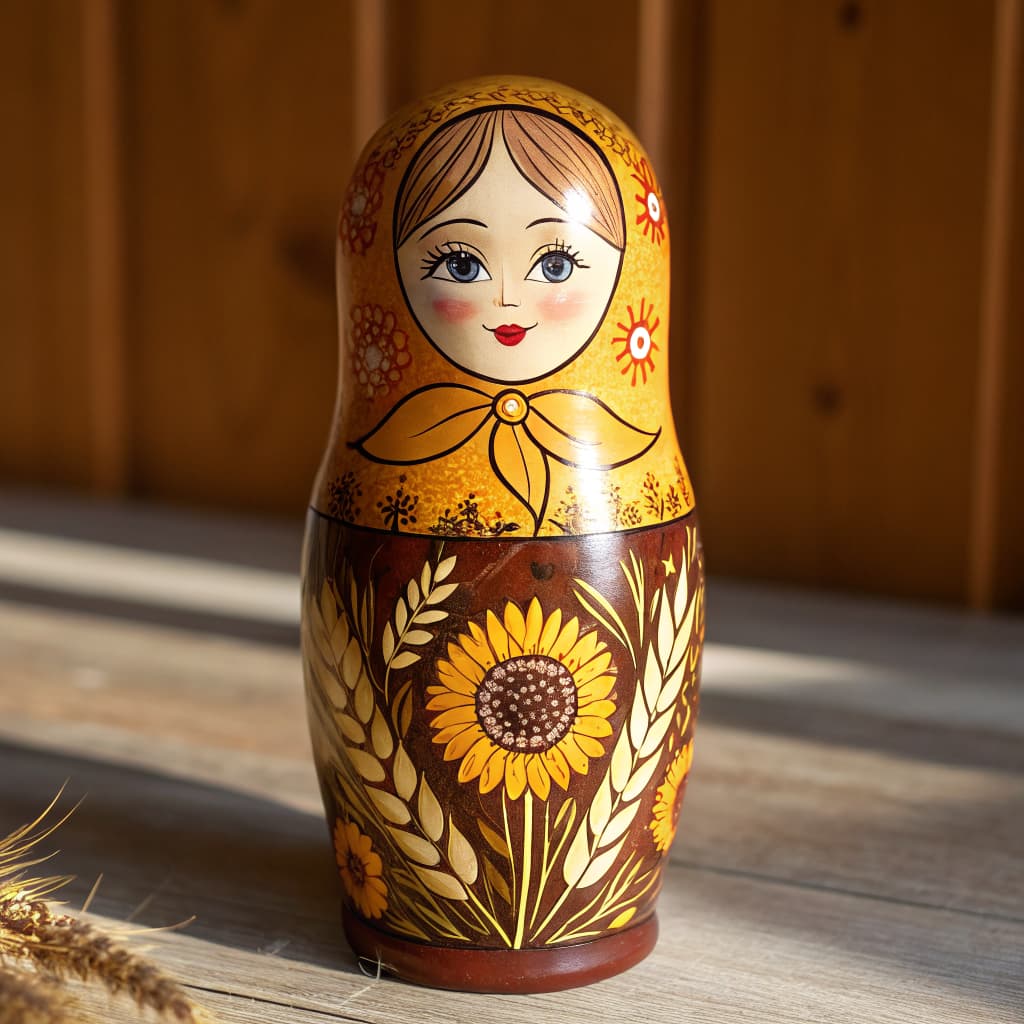
How to Spot an Authentic Hand-Painted Matryoshka
The global appetite for matryoshka dolls has created a market flooded with imitations. Tourist stalls from Prague to New York sell sets that look hand-painted from a distance but are, in fact, machine-produced in Chinese factories with designs printed on vinyl decals and glued to the wood. These counterfeits range from crude to surprisingly convincing. Whether you are spending twenty dollars or two thousand, knowing how to distinguish a genuine hand-painted matryoshka from a factory imitation is the single most important skill a collector can develop.
Start with the paint surface. A true hand-painted doll will show visible brushstrokes when examined closely, especially in areas of flat color on the apron, kerchief, or background. The strokes may be imperceptibly fine on high-quality pieces, but they will be there — slight variations in thickness, tiny ridges of paint, and the occasional micro-bleed where one color meets another. Factory dolls, by contrast, use screen-printed or heat-transferred decals that produce perfectly smooth, uniform images. Hold the doll at an angle to a light source: decal-applied designs will reflect light evenly across the entire surface, while hand-applied paint will show subtle texture variations.
Examine the faces. This is where hand painting and factory production diverge most dramatically. A skilled matryoshka painter spends more time on the face than on any other part of the doll — each eye, each lip, each eyelash is applied with a single-hair brush (known as a "liner" brush) and may require dozens of individual strokes. As a result, each face in a set will be slightly different: the curve of a smile, the thickness of an eyebrow, the precise positioning of a pupil will vary from doll to doll. In factory sets, every face is identical because the same template was used. Line up the dolls from a set and compare: if the faces are pixel-perfect duplicates, you are looking at machine work.
Check the wood. Authentic nesting dolls from established workshops are almost always made from linden (lime) or birch, selected and seasoned for at least two years before turning. The wood should feel smooth, warm, and light (for linden) or slightly heavier (for birch). The interior of each doll — the inside of both halves — should be unfinished and show the natural grain of the wood. Factory-produced dolls are sometimes made from cheaper softwoods or even MDF composite, which feels cold to the touch and shows no grain. Also check the fit: in a legitimate set, all pieces were turned from the same block of wood, so the grain orientation and color will be consistent from the largest doll to the smallest. Mismatched wood colors suggest assembled-from-parts production.
Look for the artist's signature. Reputable matryoshka artists sign their work, typically on the bottom of the largest doll. The signature usually includes the artist's name (or initials), the workshop or city of origin (Sergiev Posad, Semyonov, etc.), and sometimes the year of production. Unsigned dolls are not necessarily fake — many village-level artisans do not sign their work — but the absence of a signature on an expensive piece marketed as "museum quality" or "master artist" should raise a red flag. If a seller claims a specific artist but the doll is unsigned, ask for provenance documentation.
Evaluate the lacquer finish. Traditional matryoshka are finished with multiple coats of lacquer — often three to five layers — that protect the paint and give the doll its characteristic gloss. High-quality lacquer finishes are smooth, warm to the touch, and slightly amber-tinted. Run your fingernail lightly across the surface: genuine lacquer will feel like glass, while cheap synthetic coatings may feel plasticky or tacky. On older or vintage dolls, the lacquer may show fine crazing (a network of hairline cracks) — this is not a defect but a sign of age and authenticity, similar to the craquelure on old oil paintings.
Pay attention to price. A genuinely hand-painted matryoshka set of five pieces by a competent artisan cannot be profitably sold for less than roughly $30 to $40 at retail. A seven-piece set of genuine quality typically starts around $60 and can easily reach $150 to $300 depending on the artisan and complexity of the design. Museum-quality sets by named masters begin at several hundred dollars and can exceed $6,000 for exceptional pieces like the 30-piece Kustodiev Paintings set. If someone is offering a "hand-painted" five-piece set for $8 at a flea market, the math simply does not work — you are looking at a factory product.
At Artisanal Babushkas, every set we sell comes with the artist's name, workshop of origin, and a certificate of authenticity. We import directly from the ateliers, and we know every painter whose work appears on our shelves. If you have questions about a doll you have found elsewhere — at an estate sale, an antique shop, or online — we are always happy to help you evaluate it. The matryoshka tradition deserves to be protected, and that starts with informed collectors.