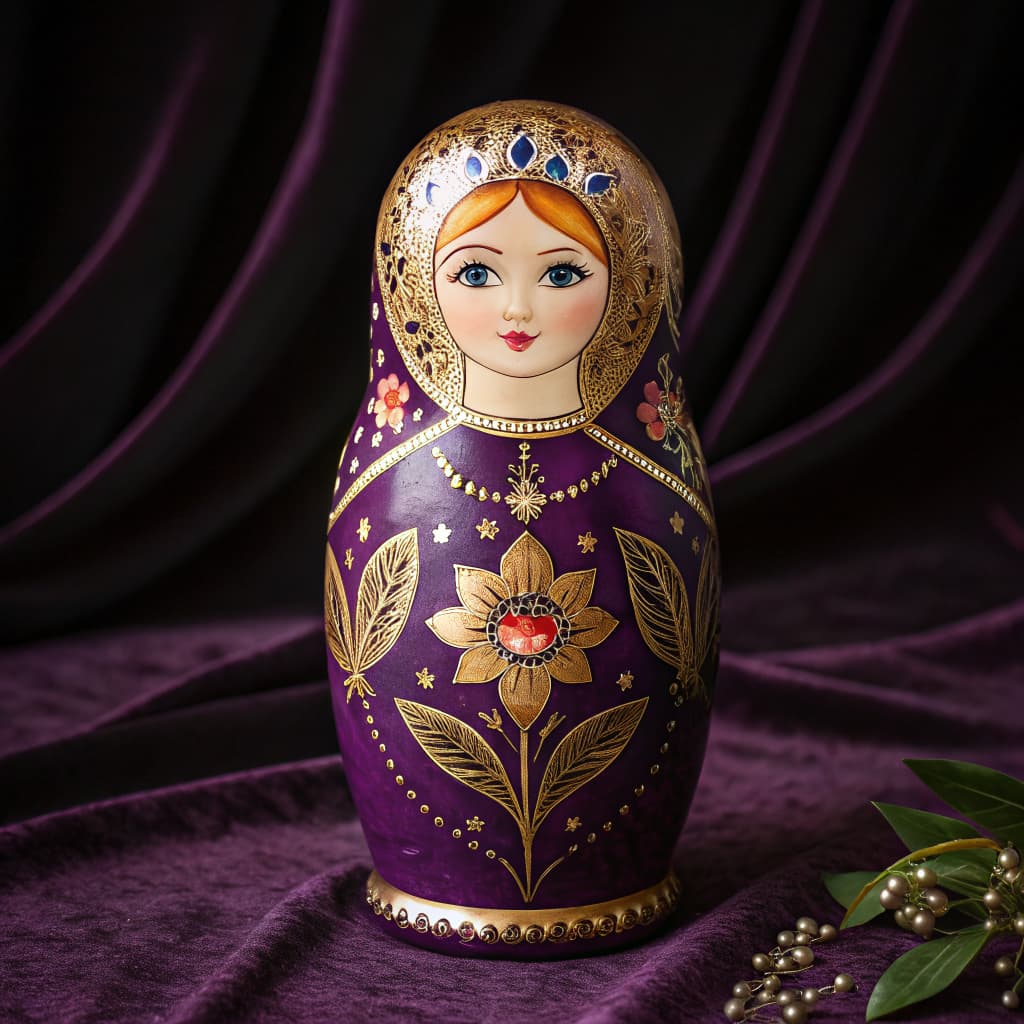
The History of the Matryoshka: From 1890 to Today
The story of the matryoshka begins in the late 1880s, at the Abramtsevo estate outside Moscow. Savva Mamontov, an industrialist and patron of the arts, had gathered some of Russia's finest painters, sculptors, and craftsmen into an artists' colony dedicated to reviving traditional Russian folk art. His brother Anatoly, who ran a children's toy workshop called "Children's Education" (Detskoye Vospitanie), acquired a curious souvenir during a visit to Japan: a nesting figure of the Shinto deity Fukurokuju (often called Fukuruma), carved on the island of Honshu. The cylindrical wooden deity opened to reveal smaller figures of his entire family inside. That Japanese import — now preserved in the Sergiev Posad Museum of Toys — would spark one of Russia's most recognizable cultural exports.
Inspired by the nesting concept, woodturner Vasily Zvyozdochkin and painter Sergey Malyutin collaborated on the first Russian version in 1890. Malyutin's design replaced the Japanese sage with a plump, rosy-cheeked peasant girl in a traditional sarafan dress and kerchief, holding a black-feathered rooster. The set consisted of eight dolls: the outermost mother gave way to daughters and sons of decreasing size, ending with a tiny swaddled infant. Zvyozdochkin turned each piece on a lathe from a single block of linden wood, and Malyutin painted them in a limited palette of reds, yellows, and greens with black contour lines. They named her "matryoshka" after Matriona, a popular peasant name derived from the Latin mater — mother.
The debut came at the Exposition Universelle in Paris in 1900, where Savva Mamontov's wife presented the dolls. The set won a bronze medal and captivated European audiences. Orders poured in, and within a decade matryoshka production had outgrown the Moscow workshop. When the Children's Education workshop closed in 1904, production shifted seventy kilometers northeast to Sergiev Posad (renamed Zagorsk during the Soviet period, 1930-1991), a town already famous for its toy-making tradition. Sergiev Posad became — and remains — the epicenter of matryoshka production.
By the 1920s and 1930s, two more production centers had emerged, each with a distinctive style. Semyonov, in the Nizhny Novgorod region, developed a brighter, more ornamental approach: large floral bouquets painted in synthetic aniline dyes on birch (rather than linden) blanks, with sets often reaching 15 to 18 pieces. Polkhov-Maidan, beginning around 1930, pushed further still — crimson, violet, and green aniline paints applied in a bold, almost childlike style with the signature dog-rose motif symbolizing motherhood. Each center developed its own tools, techniques, and aesthetic philosophy, turning a single toy concept into three distinct folk art traditions.
The Soviet era brought both standardization and subversion. State-run cooperatives mass-produced politically themed matryoshka — sets depicting Communist leaders nested by rank, or happy collective farmers embodying socialist ideals. Yet individual artisans continued to innovate. Political satire crept in: sets with Brezhnev on the outside and increasingly absurd bureaucrats within became prized underground collectibles. Meanwhile, fairy-tale and literary themes flourished, with characters from Pushkin, Tolstoy, and traditional byliny (epic tales) rendered in increasingly virtuosic brushwork.
The dissolution of the Soviet Union in 1991 opened the floodgates. Russian artists, freed from state control, began painting matryoshka with unprecedented creative ambition — portraits of jazz musicians, Renaissance madonnas, abstract expressionist patterns, and scenes from Hollywood films. At the same time, cheap mass-produced sets flooded tourist markets, many made in China with vinyl decals rather than hand painting. This bifurcation — between high-art matryoshka commanding hundreds or thousands of dollars and disposable souvenirs sold for pocket change — defines the market to this day.
In 2003, Ukrainian artist Youlia Bereznitskaia set a Guinness World Record by crafting a 51-piece matryoshka set, with the largest doll standing one foot and 9.25 inches tall. At the other end of the spectrum, museum-quality sets by contemporary masters can exceed $6,000 — the Kustodiev Paintings Nesting Doll and Book Set, a 30-piece collection reproducing the work of painter Boris Kustodiev, holds that distinction. Vintage Soviet-era sets from known workshops regularly fetch $500 to $2,000 at auction, while rare pre-revolutionary pieces are considered priceless and reside almost exclusively in museum collections.
Today, matryoshka collecting is a global phenomenon. From the Sergiev Posad Museum of Toys — which holds the original Zvyozdochkin-Malyutin set and a 48-piece monster from 1913 — to private collections in New York, Tokyo, and Berlin, the nesting doll has transcended its origins as a children's toy. At Artisanal Babushkas, we carry this tradition forward by partnering directly with family workshops that have preserved these techniques for generations. Every doll in our collection connects you to over a century of folk art heritage.