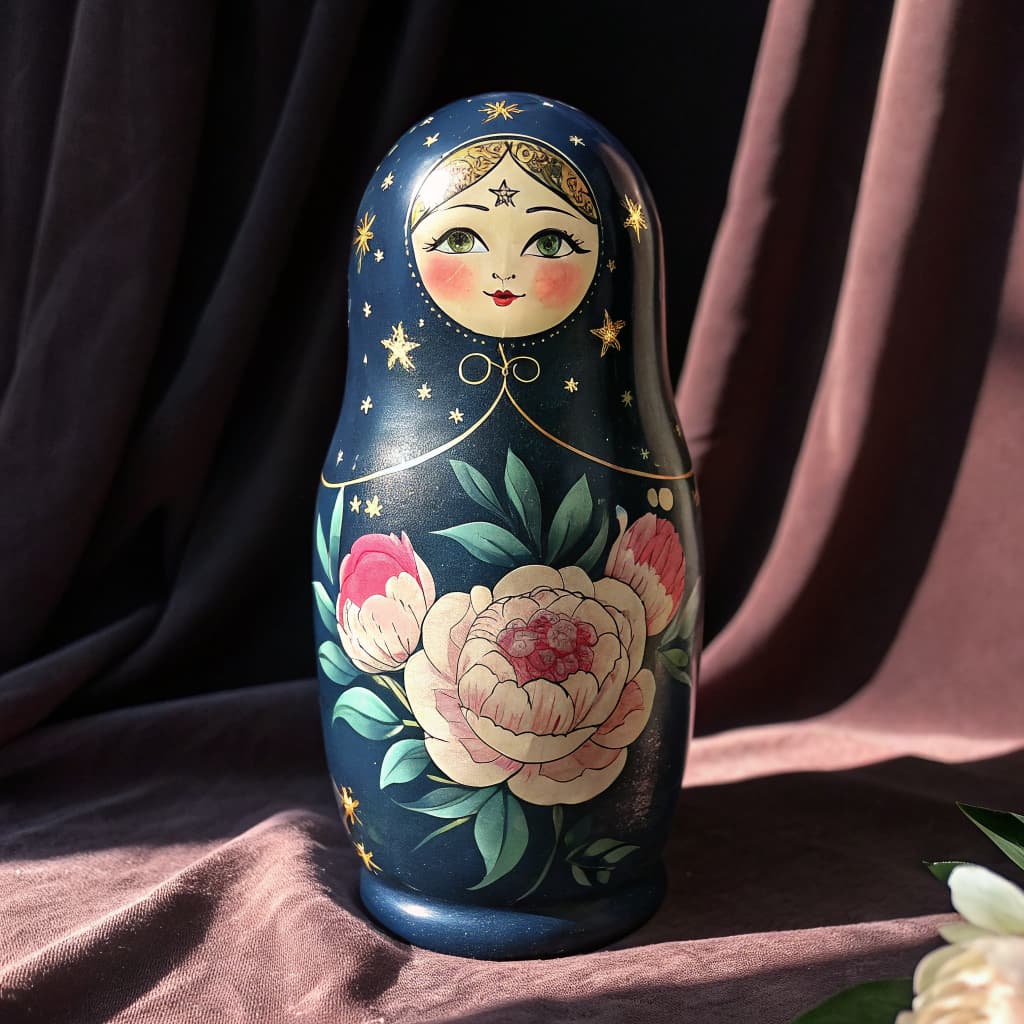
From Atelier to Auction: Famous Collections and the Market for Vintage Matryoshka
For most of the twentieth century, matryoshka dolls were regarded as charming souvenirs — the kind of thing a tourist picked up at a Moscow kiosk and placed on a bookshelf at home. But over the past three decades, a serious collector market has emerged, driven by a combination of post-Soviet scarcity, growing Western awareness of Russian folk art, and a handful of record-setting auction results that proved vintage matryoshka could command real money. Today, the distance between a five-dollar airport souvenir and a five-thousand-dollar museum-quality set is not just one of price but of an entirely different world of connoisseurship.
The most important institutional collection resides where the story began: the Sergiev Posad Museum of Toys, located in the town that has been the heart of Russian matryoshka production since 1904. The museum holds the original 1890 set created by Vasily Zvyozdochkin and painted by Sergey Malyutin — eight dolls depicting a peasant mother with her children, the outermost figure clutching a black rooster. Also in the collection is a monumental 48-piece matryoshka produced in 1913, which was the largest set ever made at the time and remains one of the most impressive examples of lathe craftsmanship in existence. The museum's holdings span the full arc of matryoshka history, from pre-revolutionary prototypes through Soviet-era political sets to contemporary art pieces.
In the United States, the Museum of Russian Icons in Clinton, Massachusetts, mounted a landmark exhibition in 2013 titled "Chip Off the Old Block," which introduced American audiences to the breadth and sophistication of the matryoshka tradition. The exhibition featured hundreds of pieces spanning the three major regional schools — Sergiev Posad, Semyonov, and Polkhov-Maidan — as well as rare Soviet-era sets and contemporary one-of-a-kind commissions. Private collectors in New York, Chicago, and San Francisco have amassed holdings that rival some museum collections, though these are rarely exhibited publicly.
At auction, the current record for the most expensive matryoshka set available for purchase belongs to the Kustodiev Paintings Nesting Doll and Book Set, which is priced at $6,128. This extraordinary 30-piece set stands 18.5 inches at its tallest and features hand-painted reproductions of works by Boris Kustodiev, the early-twentieth-century Russian painter known for his vivid scenes of provincial life. Each doll in the set reproduces a different Kustodiev painting in miniature, requiring a level of brushwork skill that pushes the matryoshka form into the realm of fine art. Other notable results include a "Snow Queen" matryoshka by the Ukrainian artist Lonuchenkova, which sold for $2,377, and large-format sets of 50 pieces that have reached $1,800 in specialized online auctions.
Several factors drive matryoshka value at auction and in the private market. Piece count matters: sets with 20 or more dolls are exponentially more difficult to produce (the smallest pieces may be under a centimeter tall) and command premiums accordingly. Provenance is critical — a doll with a documented maker, workshop, and date of production is worth substantially more than an anonymous example of equivalent quality. Condition, as with all painted objects, is paramount: chips, fading, lacquer loss, and warped nesting reduce value dramatically. And subject matter plays a role: fairy-tale and religious-iconography sets tend to outperform generic floral designs, while political-leader sets from the Soviet era have a dedicated niche audience that prizes the satirical and historical dimensions.
The Guinness World Record for the largest matryoshka set belongs to Ukrainian artist Youlia Bereznitskaia, who in 2003 produced a set of 51 individual dolls, with the largest piece measuring one foot and 9.25 inches tall. While record-breaking sets generate headlines, the bread and butter of the collector market is the well-made, five-to-ten-piece set by a recognized artisan from a respected workshop. Sets from the Soviet period (roughly 1930-1991) occupy a sweet spot of age, quality, and availability: old enough to have historical interest, common enough to be findable, and well-enough made to survive intact. Expect to pay $100 to $500 for a good Soviet-era set in excellent condition, and considerably more for sets from the 1940s and 1950s, when wartime and post-war scarcity limited production.
For aspiring collectors, the advice from experienced dealers is consistent: buy quality over quantity, learn the regional schools so you can identify what you are looking at, and always ask about provenance. A small collection of ten exceptional sets, each documented and well-displayed, is more valuable — both aesthetically and financially — than a shelf of fifty anonymous souvenirs. The matryoshka market rewards knowledge, patience, and a good eye, exactly as any serious art market does.
At Artisanal Babushkas, we see ourselves as part of this continuum. Every set we carry is fully documented with the artist's name, workshop of origin, wood type, and painting technique. We believe that today's carefully chosen purchase is tomorrow's heirloom and next century's collectible. If you are beginning a collection or looking to add a significant piece, we are always available to discuss provenance, quality, and the stories behind the dolls on our shelves.